Introduction
Bringing an older rescue dog home can be incredibly rewarding, but it can also come with challenges that are easy to underestimate. A dog who has experienced neglect, abandonment, shelter life, repeated moves, or frightening situations may struggle with confinement and being left alone. For these dogs, learning to relax in a crate is not simply a matter of closing the door and waiting for them to adjust.
If you are wondering how to crate train an older rescue dog, the most important principle is to build trust before expecting independence. The crate should become a predictable, comfortable place rather than another source of fear. This is particularly important when separation anxiety, noise sensitivity, fear of unfamiliar surroundings, or other phobias are involved.
Older dogs absolutely can learn new routines. However, a rescue dog may need considerably more patience than a puppy because you are working with an established history and emotional associations. Veterinary behavior guidance also emphasizes that crates are not appropriate for every anxious dog, particularly those who panic when confined.
The goal is not simply to make your dog stay inside a crate. The goal is to teach your dog that being alone, relaxing, and spending time away from you can be safe.
Why Crate Training an Older Rescue Dog Can Be Difficult
An adult rescue dog is not starting from a blank slate. You may not know whether the dog has previously lived in a crate, been locked away as punishment, experienced frightening transportation, or spent long periods confined in a shelter.
This history matters.


A crate that seems completely ordinary to you can feel threatening to a dog who associates enclosed spaces with unpleasant experiences. Some dogs may walk into the crate willingly but become nervous when the door moves. Others may tolerate a closed door while you are nearby but panic as soon as you disappear.
That distinction is important because crate anxiety and separation anxiety are not always the same thing.
A dog that becomes distressed specifically when the crate door closes may be afraid of confinement. A dog that becomes anxious whenever you leave, regardless of whether it is crated, may have separation-related anxiety. Some dogs experience both.
Signs of serious separation distress can include persistent barking or howling, pacing, drooling, trembling, destructive escape attempts, house-soiling, and attempts to break through doors or windows. Severe escape attempts can result in injuries, so panic should never be treated as simple disobedience.
Before You Start: Make Sure the Crate Is Actually Appropriate
Before beginning how to crate train an older rescue dog, consider whether confinement is the right solution.
A crate can be an excellent safe space for some dogs. It can provide structure during travel, veterinary recovery, household changes, or supervised rest. A properly introduced crate can eventually become somewhere your dog chooses to sleep or relax.
But a crate should not be used as a treatment for severe separation anxiety.
Humane World for Animals specifically warns that putting a dog with separation anxiety into a crate does not resolve the underlying problem. If the dog panics and tries to escape, confinement can actually create an injury risk.
For a dog who becomes frantic in a crate, a dog-proofed room, sturdy baby gate, exercise pen, or another safe confinement area may be a better option.
If your older dog suddenly develops anxiety, house-soiling, confusion, or unusual fears, arrange a veterinary check as well. Aging dogs can experience pain, sensory decline, cognitive changes, and increased anxiety, all of which can affect behavior.
Choose a Comfortable Crate and Calm Location
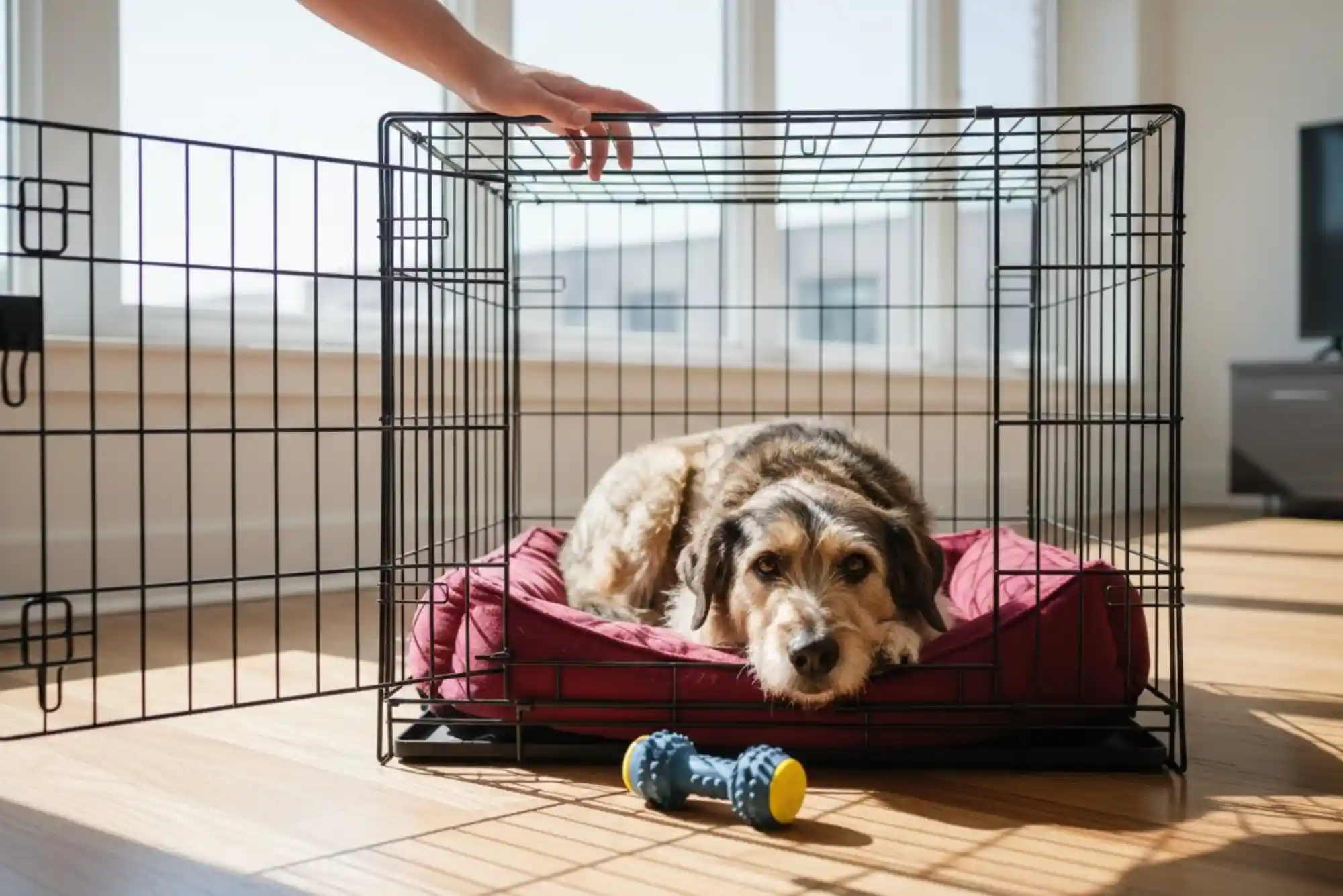
The crate should be large enough for your dog to stand up, turn around, stretch, and lie down comfortably. It should not feel like a cramped box.
Location matters just as much.
Instead of putting the crate in an isolated laundry room or garage, consider an area where the family normally spends time. Social dogs often find it easier to relax when they can see and hear their people.
For nighttime, keeping the crate near your bedroom can be especially useful during the early stages. Humane World recommends keeping older dogs nearby initially so that the crate does not immediately become associated with social isolation.
Make the space physically comfortable too. Appropriate bedding, familiar smells, and a safe chew or food-filled toy can help create positive associations.
Start With the Door Open
The first mistake many owners make when learning how to crate train an older rescue dog is closing the door too soon.
For the first stage, the crate does not need to contain the dog at all.
Simply leave the door open and allow your dog to investigate. You can place treats near the entrance, then gradually move them farther inside. If your dog walks in voluntarily, reward that decision.
Do not push, drag, or physically place a fearful dog inside.
You want your dog to discover that entering the crate predicts good things.
Meals can also help. If your dog is comfortable eating near the crate, gradually move the food bowl closer to the entrance and eventually inside. Veterinary guidance recommends using food, treats, toys, and other positive experiences to establish the crate as a comfortable retreat.
If your dog refuses food near the crate, that is useful information. It means the situation may currently be too stressful. Move the food farther away and make the exercise easier.
Teach Your Dog to Relax Inside
Once your rescue dog willingly enters the crate, resist the temptation to immediately start practicing long periods of confinement.
Instead, reward calm behavior.
Your dog might walk inside, eat a treat, turn around, and leave. That is perfectly acceptable. Repeat the process until entering the crate becomes boring and predictable.
Eventually, your dog may begin lying down inside voluntarily.
That is a major milestone.
You can quietly reward the behavior without creating excitement. The lesson you want to teach is that the crate is a place where nothing bad happens and where relaxing earns good things.
VCA guidance similarly recommends beginning with an open crate, rewarding voluntary entry, and only introducing short periods with the door closed once the dog is comfortable entering freely.
Introduce the Closed Door in Tiny Steps
When your dog is relaxed inside the crate with the door open, begin moving the door.
At first, you might close it for only a few seconds and immediately reopen it while your dog remains calm.
Then repeat.
The exact number of seconds is less important than your dog’s emotional response.
If your dog remains relaxed, you can gradually increase the duration. If your dog begins panting, whining intensely, scratching frantically, attempting to escape, or showing other signs of panic, you have progressed too quickly.
Go back to an easier stage.
This is especially important with rescue dogs because emotional setbacks can be significant. A session that lasts two minutes but leaves the dog frightened may be less useful than ten successful sessions lasting a few seconds each.
Humane World recommends gradually increasing both crate time and periods out of sight, with some dogs requiring days or weeks before they are ready for longer absences.
Build Independence Before Leaving the House
A common mistake is making the crate predict departure.
If every crate session happens immediately before you leave for work, your dog may learn that the crate means, “My person is disappearing.”
Instead, practice while you are still home.
Give your dog a safe food-stuffed toy in the crate while you sit nearby. Later, move around the room. Then briefly walk into another room and return.
Eventually, practice stepping outside the front door for a very short period.
For a dog with genuine separation anxiety, these absences may need to begin at only a few seconds. The ASPCA recommends gradually increasing absences while ensuring that the dog remains below the level at which anxiety begins.
This is where a camera can be extremely helpful. You may think your dog is relaxing after you leave, only to discover that pacing or vocalization starts immediately.
Your camera becomes a way to observe rather than guess.
How to Handle Separation Fears
Separation anxiety is not stubbornness, revenge, or a dog trying to punish you for leaving.
The dog’s distress is real.
Your training goal is therefore to change the dog’s emotional response to your absence. That means practicing departures that are short enough to remain manageable.
If your dog becomes distressed after 20 seconds, repeatedly leaving for five minutes will not teach independence. It can teach the dog that departures are frightening and unpredictable.
Instead, work below the anxiety threshold.
For example, your dog may tolerate you walking into another room for three seconds. Practice that successfully several times before gradually increasing the duration. The ASPCA recommends very short initial absences and gradual increases, with enough time between repetitions for the dog to become fully relaxed again.
Progress will not always be linear. A dog may manage two minutes one day and struggle with 30 seconds the next. That does not mean training has failed.
Stress, poor sleep, unfamiliar visitors, storms, illness, and changes in routine can all affect your dog’s ability to cope.
Helping an Older Rescue Dog With Phobias
Older rescue dogs may have fears that are unrelated to separation.
Thunderstorms, fireworks, traffic, unfamiliar people, slippery floors, household appliances, loud voices, or particular rooms can become triggers. Aging can also contribute to increased sensitivity and fear, particularly when hearing, vision, or cognitive function changes.
Do not force your dog to confront a frightening trigger at full intensity.
Instead, control the environment whenever possible. During thunderstorms, for example, you might close curtains, use background sound, and allow your dog access to a familiar safe area.
The crate can become part of that safe environment if the dog already feels comfortable there. It should never become a place where the dog is trapped while a frightening trigger is happening.
For serious phobias, veterinary or qualified behavior support can help. Behavior modification may be combined with veterinary treatment when anxiety is severe.
What to Do When Your Dog Cries in the Crate
Some vocalization does not automatically mean that crate training is failing.
First consider whether your dog needs to eliminate, is physically uncomfortable, or has been left too long.
Then look at the intensity and pattern of the behavior.
A little protest that quickly decreases is very different from frantic barking, heavy panting, drooling, trembling, repeated escape attempts, or escalating panic.
If your dog is genuinely distressed, do not use a “cry it out” approach. Instead, reduce the difficulty of the exercise and return to a stage where your dog can remain calm.
The objective is calm learning, not simply silence.
Punishing whining can also damage your dog’s trust and may make fear-based behavior worse. Positive reinforcement and gradual exposure are much more appropriate for a fearful rescue dog.
Common Mistakes to Avoid
One of the biggest mistakes is expecting an older rescue dog to follow a puppy-style timeline.
Another is using the crate only when the owner leaves. If the crate always predicts isolation, anxiety can become attached to the crate itself.
Avoid forcing your dog inside, using the crate as punishment, increasing duration too quickly, or ignoring obvious signs of panic.
You should also avoid assuming that every anxious dog needs more crate time. VCA notes that some dogs do not tolerate crates and may do better with alternative confinement arrangements. Continued anxiety, destructive behavior, or vocalization in confinement can indicate separation anxiety and may require professional behavioral support.
Most importantly, never judge progress by how long your dog can physically remain locked inside. Judge progress by how relaxed your dog remains.
How Long Does It Take to Crate Train an Older Rescue Dog?
There is no universal timeline.
Some older dogs become comfortable with a crate within days. Others need several weeks, and dogs with traumatic histories or significant anxiety may require considerably longer.
Your dog’s history, temperament, previous crate experiences, anxiety level, health, and training consistency all influence the process.
Think in terms of milestones rather than deadlines.
First, your dog enters voluntarily. Then your dog relaxes inside. Then the door can close briefly. Then you can move away. Eventually, your dog can tolerate short departures without becoming distressed.
Each step builds the foundation for the next.
When You Should Contact a Professional
If your dog has injured their mouth or paws attempting to escape, repeatedly throws themselves against the crate, becomes extremely distressed when you prepare to leave, or cannot remain calm even for very short absences, seek professional help.
A veterinarian can also check for pain, medical conditions, sensory changes, or age-related problems that could be contributing to anxiety.
Build Trust Before Expecting Independence
Learning how to crate train an older rescue dog is ultimately less about the crate and more about trust.
Your dog needs to discover that the crate is predictable, comfortable, and safe. They also need to learn that your departure is temporary and does not mean abandonment.
Take the process slowly. Reward voluntary behavior. Practice independence while you are still home. Watch your dog’s body language instead of focusing only on barking. And remember that fear is information, not defiance.
For some rescue dogs, the crate will become a wonderful personal retreat. For others, a gated room or exercise pen may be the better choice. Successful training means finding the approach that helps your individual dog feel secure.
FAQs
Can you crate train an older dog with separation anxiety?
Yes, but the crate itself does not cure separation anxiety. Some dogs find a familiar crate comforting, while others become more distressed when confined. If your dog shows heavy panting, excessive salivation, frantic escape attempts, or persistent howling, another confinement option may be safer.
How do I crate train an older rescue dog that has never used a crate?
Start with the crate door open and allow your dog to investigate voluntarily. Place treats, meals, bedding, and safe enrichment inside. Once your dog willingly enters and relaxes, introduce very short periods with the door closed. VCA recommends progressing from voluntary entry to brief closed-door sessions before attempting longer confinement.
How long does it take to crate train an older dog?
It depends on the individual dog. Some become comfortable within days, while others need weeks or longer. Rescue dogs with fear or traumatic experiences often require a slower approach. The dog’s emotional comfort should determine the pace rather than a fixed timetable.
Should I ignore my older dog crying in the crate?
Not automatically. First determine whether your dog needs a bathroom break or is uncomfortable. If the behavior is escalating into genuine panic, do not simply ignore it. Reduce the difficulty and return to a training stage where your dog can remain calm.
Is it cruel to crate an older rescue dog?
Crate training is not inherently cruel when the crate is introduced positively and used appropriately. However, forcing a fearful dog into confinement or leaving a panicked dog inside can be harmful. Some dogs are better suited to a pen, gated room, or other safe area.
Can crate training help separation anxiety?
It can provide a safe resting area for some dogs, but it does not treat the underlying separation anxiety. Effective treatment focuses on teaching the dog to tolerate being alone without experiencing escalating fear, usually through gradual desensitization and counterconditioning.
What if my rescue dog panics whenever I leave?
Start with extremely short absences and work below the point where anxiety begins. A camera can help you identify when distress starts. If your dog panics quickly, injures themselves, or cannot make progress, consult your veterinarian or a qualified behavior professional.
Related Reading: دكتور تغذية – أهمية التغذية الصحية، التشخيص، ونصائح للحياة الصحية
Related Reading: Signs of Separation Anxiety in Rescue Dogs: Proven Calming and Desensitization Routine