
Introduction
Choosing the right tactical dog harness with handle is about much more than finding a rugged-looking vest. Large breeds and service dogs need equipment that fits correctly, distributes pressure comfortably, and gives the handler reliable control when it matters. A strong handle can also make it easier to steady a dog, guide it through crowded areas, or provide brief assistance over an obstacle.
The market is full of tactical-style harnesses featuring MOLLE webbing, reinforced stitching, metal hardware, front and rear leash points, and padded handles. However, not every product marketed as “heavy duty” is designed for demanding work. Some handles are primarily decorative, while others are structurally integrated into the harness.
For large dogs, the difference matters. A German Shepherd, Labrador Retriever, Rottweiler, Great Dane, or other powerful breed can put substantial force through a harness during an unexpected pull. Service dogs also require a stable fit that does not interfere with movement or create unnecessary pressure points.
This guide explains what to look for in a tactical dog harness with handle, how to choose the right size, and which features matter most for large breeds and service dogs.
What Is a Tactical Dog Harness with Handle?
A tactical dog harness is generally a more structured harness designed around durability, control, and additional attachment options. Many models use rugged nylon, reinforced webbing, metal leash rings, adjustable straps, and MOLLE-style panels.
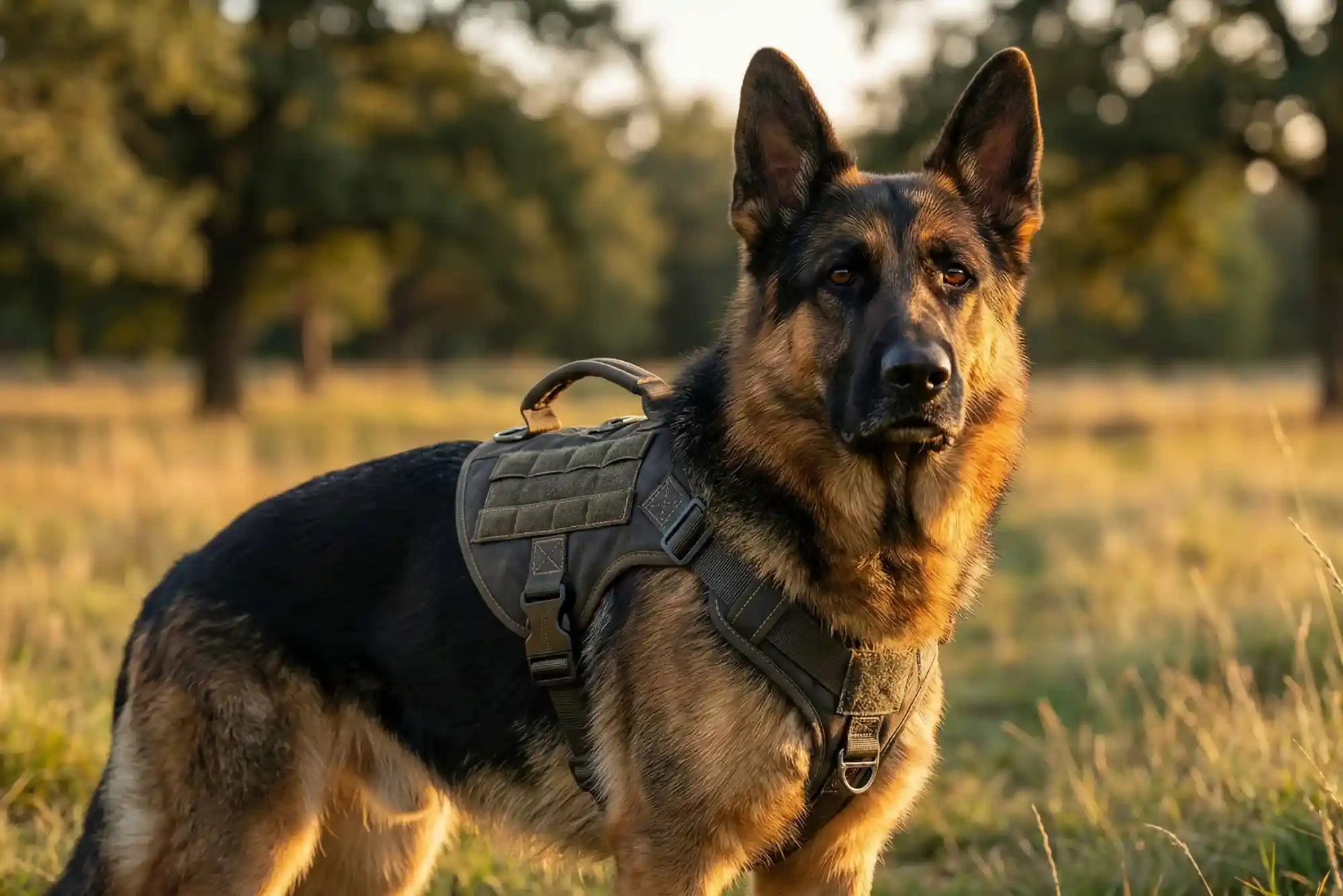
The defining feature in this article is the tactical dog harness with handle. The handle gives the handler a direct grip on the dog’s harness rather than requiring the collar to be grabbed during close-control situations.


A handle can be useful when guiding a dog through a doorway, helping it negotiate an obstacle, preventing it from moving toward a hazard, or maintaining closer control during training. It should not automatically be assumed that every handle is suitable for lifting a dog’s entire body weight.
Some manufacturers publish hardware or load ratings, while many do not. For example, a 2026 comparison found that the OneTigris X-Armor was unusual in publishing specific ratings for its buckles and D-rings.
That distinction is important because “reinforced handle” is not the same thing as a tested lifting system.
Why Large Breeds Need a Properly Designed Harness
Large dogs generate considerably more force than small dogs when they accelerate, pull, or change direction. A harness therefore needs to remain stable without squeezing the chest or interfering with the shoulders.
A properly fitted tactical dog harness with handle distributes leash pressure over a broader area of the body than a collar. The design can also provide multiple points for attaching a leash, depending on the model.
Front attachment points may be useful for certain training situations, while a rear D-ring is commonly used for ordinary walking. Some tactical harnesses combine both options. Current product comparisons show that dual attachment systems are common among working-oriented models.
The handle adds another layer of control. Instead of reaching for a dog’s neck, the handler can grip the harness itself. That can be particularly useful when a large dog needs to be redirected quickly.
However, comfort should remain a priority. A harness that is extremely rigid, heavy, or poorly positioned can become uncomfortable during long walks or extended working sessions.
Key Features to Look for in a Tactical Dog Harness with Handle
A Strong, Properly Anchored Handle
The handle is one of the first features to inspect. Look at how it connects to the harness rather than simply checking whether the product has one.
A useful handle should be attached to structural webbing and reinforced at its anchor points. Box stitching, cross stitching, and multiple reinforcement points can provide more confidence than a simple strip of fabric sewn onto the outer shell.
The position also matters. A handle located near the upper back can allow the handler to quickly steady the dog without reaching toward the neck.
Most importantly, never assume a handle is designed for full-body lifting unless the manufacturer specifically says so and provides appropriate specifications.
Durable Webbing and Fabric
Many tactical harnesses use materials such as 900D or 1000D nylon. Higher-denier fabric can provide substantial abrasion resistance, although denier alone does not determine the overall strength of a harness.
Stitching, webbing construction, hardware, and load paths all contribute to durability.
Some current tactical harnesses use 1000D nylon, while professional-oriented designs may use heavier materials.
For a large working dog, examine the complete construction rather than buying based solely on a “military grade” label.
Metal Buckles and D-Rings
Hardware becomes increasingly important as dog size and pulling strength increase.
Metal buckles and D-rings can provide a robust connection, although the specific metal, construction, and attachment method still matter. Some consumer tactical harnesses use a combination of metal and plastic components.
If your dog is exceptionally strong, inspect the hardware carefully before purchase. Look for securely attached D-rings, dependable buckles, and webbing that passes through structural areas rather than thin outer fabric.
Published specifications are particularly useful. The OneTigris X-Armor, for example, publishes hardware ratings for certain sizes, something that is not common across the category.
Multiple Adjustment Points
Large breeds rarely have identical body shapes. A deep-chested German Shepherd has a different fit requirement from a broad-chested Bulldog or a giant-breed dog.
A good tactical dog harness with handle should offer enough adjustment to keep the vest centered without becoming restrictive.
Current guides emphasize measuring the dog’s chest girth and following the manufacturer’s individual sizing chart rather than selecting a harness simply according to body weight.
Five-point adjustment systems are available on some large-dog harnesses and can help accommodate different body proportions.
How to Measure a Large Dog for a Tactical Harness
Measure the Chest Girth
Use a flexible measuring tape around the deepest part of the rib cage, generally just behind the front legs.
Keep the tape comfortably against the coat without pulling it tightly into the body.
Write down the measurement and compare it directly with the manufacturer’s chart. Do not rely on labels such as “Large” or “XL” because sizing varies significantly between brands.
Check the Neck and Shoulder Area
Chest girth is not the only measurement that matters. The harness should sit securely without pressing against the throat or restricting shoulder movement.
Deep-chested working breeds can require a different harness geometry from broad-bodied breeds. A recent tactical-harness analysis specifically notes differences in fit requirements between deep-chested, barrel-chested, and sighthound body types.
Check the Fit After Adjustment
Once the harness is fitted, watch your dog walk, turn, sit, and lie down.
The harness should remain reasonably stable instead of rotating dramatically around the torso. Straps should not dig into the armpits, and the chest structure should not interfere with normal shoulder movement.
A strong harness cannot compensate for an incorrect fit.
Tactical Dog Harness with Handle for Service Dogs
Service dogs have a particularly important requirement: the harness must support reliable handling without interfering with the dog’s trained work.
A tactical dog harness with handle can be useful for service-dog handlers who want a visible, structured harness with an integrated grip. MOLLE-style panels may also allow identification patches or other lightweight accessories.
However, tactical appearance does not automatically make a harness suitable for every service dog.
The dog should be able to move naturally and comfortably. Excessive weight, stiff materials, unnecessary pouches, or poorly positioned straps can create distractions or discomfort.
Service-dog owners should also consider whether the harness is being used for identification, general handling, training, or a specific working task. Those purposes can require different designs.
A manufacturer currently marketing a tactical service-dog harness, for example, emphasizes reinforced stitching, adjustable straps, leash attachment points, and a handle as central features.
MOLLE Webbing: Useful or Just for Appearance?
MOLLE-style webbing is one of the most recognizable features of tactical equipment. On a dog harness, it can provide attachment points for compatible pouches, patches, lights, or other lightweight accessories.
But not every harness with rows of webbing provides genuinely functional MOLLE construction.
Functional webbing needs to be appropriately spaced and securely integrated into the harness. Some consumer products use tactical-looking panels primarily for appearance or patch attachment.
For most everyday pet owners, extensive MOLLE capacity may not be necessary. For working dogs, however, modular attachment points can be useful when they serve a genuine purpose.
The key is to avoid adding unnecessary weight. A harness should remain comfortable before it becomes a platform for accessories.
Popular Tactical Harness Designs for Large Dogs
Several styles appear repeatedly in current large-dog and working-dog comparisons.
OneTigris harnesses are frequently positioned as relatively affordable tactical options, with models offering features such as MOLLE panels, handles, and multiple leash attachment points. Current product comparisons also highlight the brand’s X-Armor model for its published hardware ratings.
ICEFANG models are another common choice for large and powerful dogs. Current guides highlight their broad chest construction, front and rear attachment points, and metal hardware on certain models.
Rabbitgoo’s tactical harnesses are also available in larger sizes and have been described as suitable for broad-chested and very large dogs. Its designs commonly combine padding, adjustment points, metal attachment hardware, and MOLLE-style panels.
Ruffwear’s Web Master line takes a somewhat different approach. Rather than focusing heavily on the military aesthetic, its designs emphasize secure fit, multiple adjustment points, and durable construction. Current industry comparisons identify the Web Master Pro as a heavier-duty option using substantial materials and multiple adjustment points.
The right choice depends on your dog’s measurements and intended use rather than the appearance of the vest.
Safety Tips for Using a Tactical Dog Harness
Even a well-built tactical dog harness with handle needs regular inspection.
Check the stitching around the handle, leash rings, and adjustment points. Look for fraying, loose threads, cracked buckles, bent rings, or stretched webbing.
If your dog regularly pulls hard, inspect the harness more frequently. A harness can gradually develop damage that is difficult to see during a quick glance.
Avoid using an ordinary grab handle as a lifting device unless the manufacturer specifically approves that use. A handle intended for close control is not necessarily engineered to support the dog’s entire body weight.
Also consider the weather. Heavy tactical materials and extensive padding can become warm in hot conditions. Breathable mesh and appropriate construction can be particularly valuable during outdoor work or long walks.
Common Mistakes When Buying a Tactical Dog Harness
Choosing by Weight Alone
Two dogs weighing 80 pounds can have completely different chest shapes. Always use actual measurements.
Assuming “Military Grade” Means Strong
Marketing terminology does not replace material specifications, stitching details, or hardware ratings.
Ignoring Shoulder Movement
A harness should provide control without unnecessarily restricting the dog’s natural gait.
Treating Every Handle as a Lifting Handle
This is one of the most important distinctions. A grab handle may be designed for stabilization and short-term control rather than carrying the dog.
Adding Too Much Gear
MOLLE capability can be useful, but loading every available attachment point can make the harness unnecessarily heavy.
Choosing the Right Tactical Dog Harness with Handle
A quality tactical dog harness with handle can be valuable equipment for large breeds, working dogs, and service dogs, but the tactical appearance should never be the deciding factor.
Focus on the fundamentals: accurate sizing, secure adjustment, durable webbing, dependable hardware, reinforced handle construction, comfortable shoulder clearance, and appropriate weight. For working applications, published hardware specifications can provide additional information that generic “heavy duty” claims cannot.
A large dog needs a harness designed around its actual body and behavior. A service dog needs equipment that supports its work without becoming an unnecessary distraction. And every dog needs a harness that allows comfortable, natural movement.
Before purchasing, measure your dog’s chest, study the manufacturer’s size chart, inspect the handle and attachment points, and consider exactly how you will use the harness.
FAQs
What is the best harness for a large dog?
The best harness for a large dog depends on chest size, body shape, leash behavior, and intended use. A properly fitted harness with strong attachment points, appropriate adjustment, and a securely integrated handle can provide useful control. Current large-dog guides emphasize measuring girth and choosing based on the manufacturer’s sizing chart rather than relying on weight categories alone.
Are tactical harnesses good for dogs?
A tactical harness can be useful when a dog needs durable construction, additional control points, or modular attachments. However, tactical styling does not automatically mean superior quality. Materials, stitching, hardware, fit, ventilation, and the dog’s intended activity should determine whether a particular harness is appropriate.
What harness is best for a service dog?
A service dog needs a harness that fits securely, allows natural movement, and supports the dog’s specific working requirements. A tactical dog harness with handle can be appropriate when the handle and overall construction match the handler’s needs. Identification and working requirements should also be considered separately from the harness’s appearance.
Is it better to have a handle on a dog harness?
A handle can be especially useful for large or working dogs because it provides a direct point for close control. It can help a handler steady or redirect a dog without grabbing the collar. However, the handle should be properly reinforced, and its intended use should be confirmed with the manufacturer.
What size harness should I get for my large dog?
Measure your dog’s chest girth and compare it with the exact sizing chart for the harness you are considering. Do not assume that XL means the same thing across brands. Some tactical harnesses cover substantially different chest ranges even when they use the same size label.
Can you lift a dog with a tactical harness handle?
Not necessarily. A handle designed for control may not be rated for lifting. Unless the manufacturer specifically states that the handle and harness are designed for lifting and provides appropriate load information, treat the handle as a control point rather than a lifting device.